
The right way to wire your Tomball garage for a heavy duty workshop
Converting your Tomball garage into a heavy-duty workshop means more than just adding a workbench. It requires a complete electrical system upgrade to safely power everything from table saws to dust collectors. Houston’s humid climate and strict local codes make proper wiring essential for both safety and performance. Electrical Houston.
Standard garages have a single 15- or 20-amp circuit that cannot handle the load of multiple power tools running simultaneously. When you add high-amperage equipment like welders or air compressors that existing circuit will trip constantly or create dangerous overheating conditions. This guide walks you through the right way to upgrade your garage’s electrical system for a fully functional workshop.. Read more about How to protect your home office equipment in The Woodlands from sudden voltage spikes.
Understanding your workshop’s power needs
Before installing any wiring calculate the total electrical load your tools will require. A typical table saw needs 15-20 amps on a 120-volt circuit. Add a dust collector at 10-15 amps and an air compressor at 15-20 amps and you have already exceeded what most garage circuits can handle. If you plan to run multiple tools at once or add 240-volt equipment like a welder you will need a dedicated sub-panel with multiple circuits.
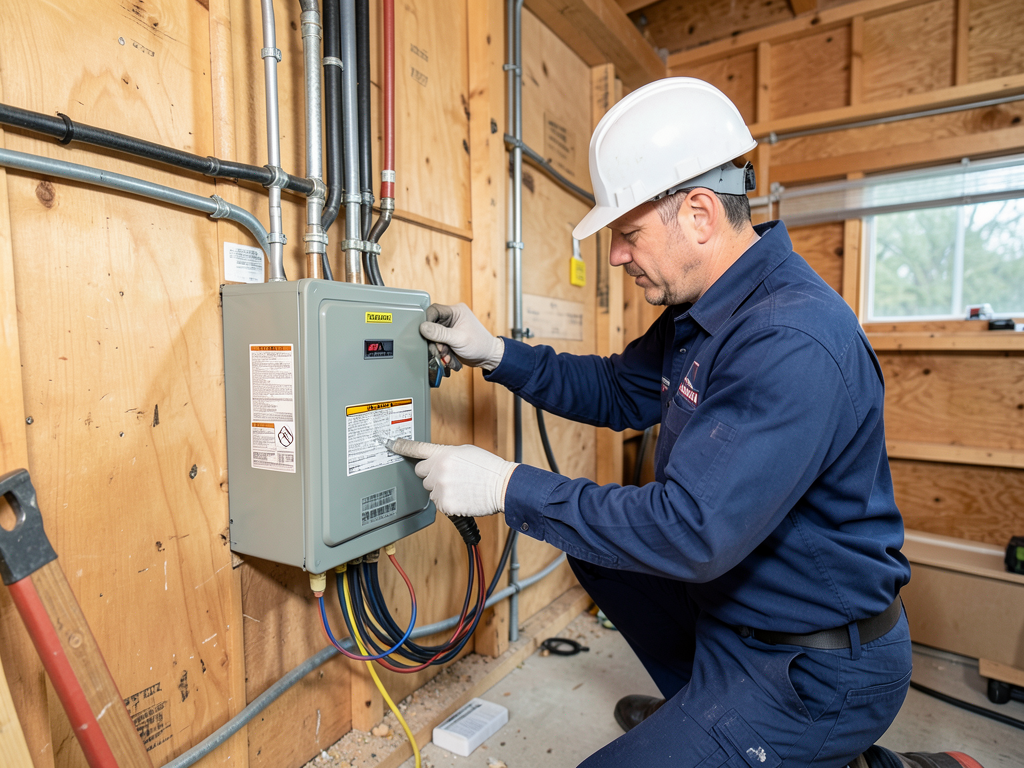
Heavy-duty workshops require a 60 to 100-amp sub-panel installed in the garage. This provides enough capacity for dedicated 20-amp 120-volt circuits for smaller tools and lighting plus 240-volt circuits for larger equipment. The sub-panel should be mounted on a wall near your main electrical panel for shorter wire runs and easier maintenance.
Sub-panel installation for garage workshops
A sub-panel installation forms the foundation of any serious workshop electrical system. The process begins with calculating your total load to determine the proper amperage. For most Tomball workshops with multiple tools and future expansion plans a 100-amp sub-panel offers the best balance of capacity and cost.
The installation requires running a feeder cable from your main panel to the garage sub-panel. This cable must be sized according to the National Electrical Code based on your calculated load. For a 100-amp sub-panel you will typically need 3 AWG copper or 1 AWG aluminum conductors. The cable must be protected in conduit when running through walls or underground. National Electrical Code requirements.
Proper grounding proves critical in Houston’s humid climate. The sub-panel must have a separate ground bus that is not bonded to the neutral. This prevents ground loops and ensures fault currents have a clear path to earth. Many Tomball homes sit on expansive clay soil that can shift over time so all ground connections should be made with weatherproof corrosion-resistant materials.
Dedicated circuits for workshop tools
Every major tool in your workshop should have its own dedicated circuit. This prevents overloads and allows each tool to operate at peak performance. Here is what you will need for common workshop equipment:
- Table Saw Circuit
A 20-amp 120-volt dedicated circuit with 12 AWG wire. This powers most table saws and provides clean power for accurate cuts.. Read more about Getting power to your Magnolia Park workshop or backyard studio.
- Air Compressor Circuit
A 20-amp 120-volt dedicated circuit with 12 AWG wire. Compressors draw high starting current so a dedicated circuit prevents tripping.
- 240-Volt Equipment Circuits
30-amp 240-volt circuits for welders large dust collectors or kilns using 10 AWG wire. These require special outlets and proper breaker sizing.
- Lighting Circuits
Separate 15-amp 120-volt circuits for LED shop lights. This keeps lighting independent from tool circuits for safety.
Each dedicated circuit must be protected by the correct breaker size. Using an oversized breaker creates a fire hazard because the wire could overheat before the breaker trips. All circuits in a garage must be GFCI protected per NEC requirements either through GFCI breakers or GFCI receptacles at the first outlet on each circuit. Protect Your Tech With Professional Whole House Surge Protection in Cypress.
240-volt outlets for heavy machinery
Many workshop tools require 240-volt power for optimal performance. Table saws with 3 HP motors large dust collectors and welders all run more efficiently on 240 volts than 120 volts. The higher voltage means lower current draw which reduces voltage drop and allows longer cable runs without power loss.
Installing 240-volt outlets requires running two hot conductors one neutral and one ground. The most common workshop outlet is the NEMA 6-20R for 20-amp circuits or NEMA 6-30R for 30-amp circuits. These outlets have different configurations to prevent plugging 120-volt equipment into 240-volt circuits.
Proper wire sizing proves critical for 240-volt circuits. A 30-amp circuit needs 10 AWG copper wire minimum. For longer runs over 50 feet you may need to upsize to 8 AWG to prevent voltage drop. All 240-volt circuits must be in conduit when run through walls or ceilings and all connections should be made in approved junction boxes with proper strain relief.
Lighting design for workshop visibility
Good lighting proves essential for workshop safety and precision work. Many garages come with a single bare bulb that creates dangerous shadows. A proper workshop lighting layout uses multiple high-lumen LED fixtures mounted to eliminate shadows and provide even illumination.
For a typical two-car garage workshop you will need 6000-8000 lumens of light. This translates to about 60-80 watts of LED lighting or six to eight 4-foot LED shop light fixtures. Mount lights on the ceiling with even spacing to avoid dark spots. For workbench areas add under-cabinet LED strips or adjustable task lights.
Color temperature matters for workshop lighting. Choose 4000K to 5000K LED fixtures that provide bright neutral light similar to daylight. This makes it easier to see fine details and reduces eye strain during long projects. All workshop lighting should be on separate circuits from power tools so you are not working in the dark when a tool trips a breaker.
Conduit vs. Romex in finished garages
Choosing between conduit and Romex cable depends on your garage’s construction and local codes. Romex proves easier to install in unfinished garages with open stud walls. However Houston’s building codes and the National Electrical Code require conduit for most garage wiring especially in finished spaces.
Conduit offers several advantages for workshop wiring. It provides superior protection against physical damage from moving equipment or dropped tools. It also makes future modifications easier since you can pull new wires through existing conduit. In Houston’s humid climate conduit prevents moisture damage to conductors and makes it easier to seal penetrations against pests.
For underground runs from the main panel to a detached garage workshop conduit proves mandatory. Use PVC conduit buried at least 18 inches deep or use direct burial rated cable in conduit for added protection. All conduit fittings must be watertight with proper bushings to prevent wire damage. The Top Rated Licensed Electricians Serving the River Oaks Area.
Air compressor and dust collection electrical needs
Air compressors and dust collection systems prove essential for many workshops but have specific electrical requirements. Compressors draw high starting current often 3-5 times their running amps which can trip standard breakers. They need dedicated circuits with proper breaker sizing and often benefit from slow-blow fuses. slow-blow fuses for compressors.
Dust collection systems vary widely in power needs. Small shop vacuums run on standard 120-volt circuits but central dust collection systems with 1.5 HP or larger motors need 240-volt power. These systems also require proper grounding to prevent static electricity buildup which can prove dangerous in dust-heavy environments.
Both systems should be wired with outlets mounted at comfortable working heights. For dust collectors consider adding a remote control switch so you can turn the system on and off without walking across the shop. All outlets for these systems must be GFCI protected and mounted in weatherproof boxes if mounted near dust collection ports.
Harris County electrical code compliance
Tomball and Harris County follow the National Electrical Code with local amendments. All workshop wiring must be performed by a licensed electrician and inspected by the county. Permits prove required for sub-panel installations new circuits and any changes to your electrical service. Harris County electrical permitting.
Key code requirements for garage workshops include GFCI protection for all 120-volt receptacles AFCI protection for living space circuits proper grounding and correct wire sizing. The code also requires minimum receptacle spacing – no point along a wall should be more than 6 feet from an outlet.
For Houston’s climate additional considerations include weatherproof covers for outdoor outlets proper sealing of conduit penetrations to prevent moisture intrusion and corrosion-resistant materials for all outdoor or garage-mounted equipment. The expansive clay soil in many Tomball neighborhoods can cause foundation movement so all outdoor electrical work must account for potential shifting. How to Plan Your Outdoor Landscape Lighting in The Woodlands Without Overspending.
Smart garage features and EV charging integration
Modern workshops often include smart features that require additional electrical planning. Smart switches and outlets allow you to control shop lighting and equipment from your phone. Security cameras and motion sensors need dedicated circuits with battery backup for continuous operation.. Read more about Planning the perfect outdoor kitchen in Memorial Park (Don’t forget the electrical requirements).
Many homeowners add EV chargers to their garages which creates an excellent opportunity to upgrade your electrical system for workshop use. A 50-amp EV charger circuit can double as a 240-volt outlet for your welder when you are not charging your car. This shared use maximizes your electrical investment. How to Get a Tesla Home Charger Installed in Katy Without the Stress.
Smart workshop systems can include automated dust collection that turns on when you start a tool LED lighting that adjusts based on natural light levels and tool tracking systems that monitor power usage. These features require proper network wiring and often need their own dedicated circuits to prevent interference with sensitive equipment.. Read more about Selecting the best Level 2 charging station for your Ford F-150 Lightning in Memorial.
Safety protocols for dust-heavy environments
Workshops with woodworking or other dust-producing activities require special electrical safety considerations. Fine dust proves combustible and can create explosion hazards if ignited by electrical sparks. All switches and motors in dust-heavy areas should be explosion-proof or totally enclosed.
Ground all metal dust collection ducts to prevent static buildup. Use grounded metal conduit for all electrical wiring in dust collection areas. Install metal outlet boxes rather than plastic ones and use metal-faced switches that will not create sparks if dust accumulates on them.
Consider adding a separate sub-panel just for dust collection and air handling equipment. This keeps these critical safety systems isolated from tool circuits and allows you to quickly shut down dust collection without affecting your main workshop power. All dust collection wiring should be in metal conduit and all connections should be made with antioxidant paste to prevent corrosion.
Cost factors for garage workshop wiring
The cost of wiring your garage workshop depends on several factors. A basic upgrade with a 60-amp sub-panel and dedicated circuits for essential tools typically runs $2000 to $3500. A comprehensive workshop setup with 100-amp service multiple 240-volt circuits and professional lighting design can cost $4000 to $7000 or more.
Factors that increase cost include the distance from your main panel to the garage the need for underground conduit runs and the complexity of your lighting design. Finishing work like patching drywall after conduit installation adds to the total. However proper wiring prevents costly tool damage and reduces fire risks making it a worthwhile investment.
Many homeowners find that bundling workshop wiring with other electrical upgrades saves money. If you are planning to add an EV charger or upgrade your main panel anyway combining these projects with your workshop wiring can reduce overall costs by 15-20% through shared labor and materials.
Permitting process in Tomball
Obtaining permits for your garage workshop wiring involves several steps. First you will need detailed electrical plans showing your proposed circuits panel locations and load calculations. These plans must be submitted to the Harris County Permit Office along with your permit application and fee.
The permit process typically takes 1-2 weeks for review. Once approved you can begin installation. The work must be inspected in stages – rough inspection after running wires but before closing walls and final inspection after all devices are installed and the system is operational.
Working with a licensed electrician familiar with Tomball’s permitting process can streamline this timeline. They can ensure your plans meet all code requirements before submission reducing the risk of costly revisions. Many electricians also handle the permit process as part of their service saving you time and potential headaches.
Maintenance and future expansion
After installing your workshop wiring proper maintenance ensures long-term reliability. Check all connections annually for tightness especially in Houston’s humid climate where thermal expansion can loosen terminals. Test GFCI outlets monthly and replace any that fail to trip properly.
Plan for future expansion by installing oversized conduit when possible. A 1-inch conduit can be upgraded to handle more wires later while a 3/4-inch conduit may prove difficult to modify. Consider leaving extra breaker spaces in your sub-panel for future circuits.
Document your electrical system with a circuit directory showing what each breaker controls. This helps with troubleshooting and makes it easier for future homeowners or electricians to understand your setup. Keep all permits and inspection reports with your home documentation.
Frequently Asked Questions
How much does it cost to wire a garage workshop in Tomball?
The cost varies based on your needs but typically ranges from $2000 to $7000. Basic setups with essential circuits cost less while comprehensive workshops with multiple 240-volt circuits and professional lighting design cost more.
Do I need a permit for garage workshop wiring in Harris County?
Yes permits prove required for all new circuits sub-panels and major electrical modifications. The work must be performed by a licensed electrician and inspected by county officials.
Can I install workshop wiring myself to save money?
Texas law requires a licensed electrician for most electrical work. DIY wiring can void your insurance fail inspection and create serious safety hazards. Professional installation ensures code compliance and safety.
What size sub-panel do I need for a garage workshop?
Most workshops need a 60 to 100-amp sub-panel. Calculate your total load based on your tools then add 20% for future expansion. A 100-amp panel offers the most flexibility for growing workshops.
How long does garage workshop wiring installation take?
Installation typically takes 2-4 days for a standard workshop. This includes running wires installing the sub-panel mounting outlets and lighting and passing inspections. Complex projects may take longer.
Should I use conduit or Romex for garage workshop wiring?
Conduit proves required by most local codes and offers better protection in Houston’s climate. It is especially important for underground runs and in finished garages where wires need extra protection.
You may also find this helpful. Comparing home battery storage options for Alief families who want more than just a generator.
You may also find this helpful. How to wire your Astrodome area media room for the ultimate theater experience.
You may also find this helpful. Powering a new backyard tiny house or ADU in The Heights without blowing a fuse.